Parin SteelsStainless Steel Kitchenware Manufacturer
The 2026 market for Stainless Steel Khumcha Plate manufacturers reflects a wider shift toward durable, hygienic, and cost-conscious foodservice equipment. World Stainless reported global crude stainless steel production of approximately 58.4 million tonnes in 2023, showing the material’s continuing industrial importance. Grand View Research also identifies foodservice and hospitality as important stainless steel application sectors, supported by corrosion resistance and long service life.
A reliable manufacturer must offer more than polished surfaces. Buyers should examine food-contact grades, especially 304 stainless steel, consistent thickness, rolled edges, weld quality, and measurable load performance. A khumcha plate should feel balanced in the hand, resist staining after repeated washing, and remain stable beside hot serving vessels. Small details matter.
As foodservice consultant Michael Oshman has stated, “Sustainability is not a trend; it is a responsibility.” This principle applies to supplier selection, although the quotation is broader than khumcha manufacturing itself. The strongest 2026 manufacturers will combine responsible sourcing, documented quality control, export experience, and practical customization. Some supplier claims still deserve closer inspection. “Food grade” alone is not enough.
This guide compares leading Stainless Steel Khumcha Plate manufacturers through material specifications, production capacity, finishing standards, certifications, packaging, delivery reliability, and after-sales support. The goal is not to reward the largest factory automatically. It is to identify suppliers that can deliver consistent plates, realistic lead times, and dependable performance across demanding commercial kitchens.
What Is a Stainless Steel Khumcha Plate?
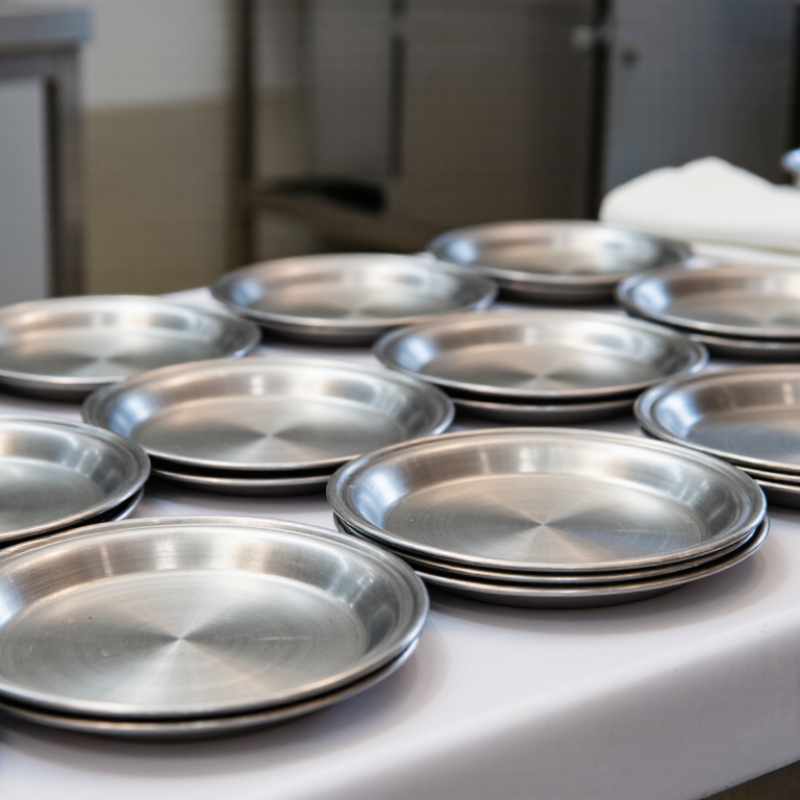
A stainless steel khumcha plate is a durable serving plate used for snacks, meals, and shared dishes. Its name and shape can vary across South Asian regions. In many kitchens, it has a shallow bowl form, a raised rim, and enough depth for gravies or street-style foods. The curved edge helps reduce spills while carrying food from the kitchen to the table.
Most khumcha plates are made from food-contact stainless steel, commonly grades 304 or 430. Grade 304 usually offers stronger corrosion resistance, especially around acidic foods and frequent washing. Grade 430 can be more economical, but its performance depends on cleaning habits and moisture exposure. A practical inspection should include the welds, rim smoothness, base stability, and overall thickness. Thin metal feels light, yet it may dent after repeated commercial use.
From hands-on kitchen use, a good plate should sit flat and remain comfortable when filled with hot rice or curry. The surface should be polished evenly, without sharp edges or deep scratches. Avoid harsh chlorine cleaners, because they can damage the finish over time. I have found that “stainless” does not always mean maintenance-free. Poor forming, trapped moisture, or careless storage can still create stains. Measurements also deserve attention, since a plate described as khumcha may be smaller or deeper than expected. Checking actual diameter, depth, weight, and food-contact documentation gives buyers a more reliable basis for comparison.
| Data Dimension | Typical Industry Data | Why It Matters When Comparing Manufacturers |
|---|---|---|
| Product Definition | ||
| What is a khumcha plate? | A shallow, reusable stainless steel serving plate or food-service dish. The term “khumcha” is used regionally, so the exact shape and size can differ between markets. | A qualified manufacturer should confirm the intended application, regional terminology, rim profile, and required dimensions before production. |
| Common applications | Restaurants, catering, canteens, street-food service, household dining, buffet presentation, and institutional kitchens. | Commercial food service generally requires stronger construction, easier cleaning, and better resistance to repeated handling than household-use products. |
| Typical shape | Round or slightly oval, usually with a flat or gently recessed center and a raised rolled or reinforced rim. | Consistent forming and a smooth rim help reduce sharp edges, improve stacking, and support safe handling. |
| Material and Construction | ||
| Most suitable stainless-steel grade | AISI 304 is widely selected for food-contact tableware because of its corrosion resistance and cleanability. | Material certificates or heat-number traceability provide stronger verification than a generic “stainless steel” description. |
| Alternative stainless-steel grades | AISI 430 may be used for lower-cost, lower-corrosion-demand applications. AISI 316 offers higher resistance in chloride-rich or more aggressive environments but is less common for standard plates. | The grade should match the food environment, cleaning chemicals, humidity, salt exposure, and target price. |
| Typical sheet thickness | Approximately 0.5–1.0 mm for many lightweight to medium-duty plates; heavier commercial designs may use thicker material. | Thickness affects rigidity, dent resistance, weight, nesting performance, and freight cost. It should be specified as a tolerance-controlled value. |
| Manufacturing processes | Sheet cutting, stamping or deep drawing, edge rolling, trimming, polishing, washing, inspection, and protective packing. | Stable tooling and controlled forming reduce uneven rims, wrinkles, deformation, and dimensional variation. |
| Surface finish | Common options include bright polish, satin finish, brushed finish, or a standard mill finish suitable for subsequent polishing. | The finish should be uniform, free from visible pits and burrs, and compatible with the buyer’s cleaning and presentation requirements. |
| Food-contact requirements | The finished product should be manufactured from suitable food-contact materials and must not have flaking coatings, exposed burrs, or residues from fabrication. | Ask for material declarations, inspection records, and cleaning-process details where food-contact compliance is required. |
| Typical Product Dimensions | ||
| Common diameter range | Approximately 180–330 mm, depending on whether the plate is intended for snacks, individual meals, shared dishes, or buffet service. | Manufacturers should confirm outside diameter, usable inner diameter, rim width, and dimensional tolerance on the technical drawing. |
| Typical depth | Approximately 15–40 mm for shallow plate designs; deeper profiles may be specified for saucy or liquid-containing foods. | Depth influences usable capacity, stacking height, stability, and the risk of spills during service. |
| Typical unit weight | Often approximately 120–450 g, depending on diameter, thickness, rim construction, and stainless-steel grade. | Weight consistency is a practical indicator of material control and helps buyers estimate shipping and handling costs. |
| Stacking requirement | Commercial plates are commonly designed for nested storage, with controlled rim geometry and sufficient clearance between units. | Request a nesting-height measurement for a specified quantity, especially when storage space or transport efficiency is important. |
| Manufacturer Selection Criteria | ||
| Dimensional tolerance | A clear product drawing should define tolerances for diameter, depth, thickness, flatness, and rim height. The acceptable value depends on the design and production method. | Written tolerances make incoming inspection objective and help prevent disputes over fit, stacking, and appearance. |
| Quality inspection points | Check material grade, thickness, diameter, flatness, rim safety, surface finish, stains, dents, burrs, welds if present, and packaging condition. | A documented inspection plan is more reliable than visual checking alone and supports repeatable quality across production batches. |
| Corrosion-resistance verification | Verification may include material identification, supplier certificates, and appropriate corrosion or surface evaluations based on the grade and intended environment. | Testing should reflect actual use, particularly where plates contact salt, acidic foods, chlorinated water, or strong detergents. |
| Customization capability | Common customizations include diameter, depth, thickness, rim design, finish, packing quantity, and non-coated decorative patterns. | Manufacturers with controlled tooling and documented samples are better positioned to reproduce a customized design consistently. |
| Packaging standards | Typical protection includes individual separation or paper interleaving, moisture-resistant cartons, edge protection, and export-appropriate outer packaging. | Packaging should prevent scratches, staining, deformation, and movement during domestic or international transportation. |
| Commercial comparison factors | Compare confirmed material grade, thickness, usable dimensions, finish quality, production capacity, inspection method, packaging, lead time, and total delivered cost. | The lowest unit price may not provide the best value if it is associated with thinner material, inconsistent sizing, higher defect rates, or inadequate packaging. |
| Recommended Buyer Specification | ||
| Minimum information for a purchase order | Product name, drawing or photo, stainless-steel grade, thickness, outside diameter, inner diameter, depth, finish, acceptable tolerances, quantity, packing method, inspection requirements, and delivery terms. | A complete specification reduces ambiguity and allows different manufacturers to quote on the same technical basis without relying on brand names. |
| Best general-purpose configuration | AISI 304 stainless steel, smooth food-contact surface, rolled safety rim, stackable round profile, and medium-duty thickness selected according to the required diameter and usage frequency. | This configuration provides a practical balance of corrosion resistance, hygiene, durability, appearance, and lifecycle value for many food-service applications. |
Food-contact stainless steel offers corrosion resistance and tolerates repeated washing. Many kitchens choose 304-grade steel for practical durability. Verify the grade through supplier documents.
Look for a rolled rim, smooth corners, and a stable flat base. These details reduce sharp edges, food buildup, and tipping. Small details matter.
No. Mirror polishing looks attractive, while satin finishes hide minor scratches better. Shine alone may conceal uneven forming or rough welds.
They suit homes, cafeterias, workplace canteens, catering events, and institutional dining. Their stackable shape saves shelf space. This helps busy kitchens.
Thicker plates usually feel safer when carrying hot meals. However, steel transfers heat quickly. Handles, cloths, or serving tools may still be needed.
Check dimensions, weight, thickness, edge finishing, cleaning needs, replacement terms, and lead times. Request sample plates first. Do not rely only on price.
Compare three samples under the same light. Measure diameter and thickness with simple tools. Inspect the rim, joints, underside, and flat base.
Ask for steel-grade evidence, food-contact documentation, finish details, tolerances, and inspection records. Confirm production capacity and minimum order requirements in writing.
Factory photos provide limited evidence. Independent inspection can reveal uneven sizes, weak packaging, or inconsistent batches. Good samples do not guarantee repeat quality.
Approve a production sample and review random pieces before shipment. Keep a written checklist. Fast replies are not always proof of dependable production. I would not assume otherwise.
A Stainless Steel Khumcha Plate is a durable, reusable serving and preparation utensil designed for demanding kitchen, catering, hospitality, and food-service environments. This article explains its main features, including corrosion resistance, smooth surfaces, easy cleaning, strength, balanced weight, and compatibility with different food presentation needs. It also discusses how to assess manufacturers by reviewing material grades, forming accuracy, welding or polishing quality, production consistency, hygiene standards, certifications, and customer support.
The guide presents practical considerations for identifying leading Stainless Steel Khumcha Plate manufacturers in 2026 without focusing on specific brand names. It compares quality control, customization options, order quantities, packaging, pricing transparency, production capacity, lead times, and export experience. Buyers will also learn how handle styles, dimensions, surface finishes, logos, and packaging can be tailored to different markets while maintaining dependable performance and safe, compliant production.