Mumbai, Maharashtra, India +91-8047528682 GST Verified: 27AALHS2479A1Z0 92% Buyer Response Rate
0%

Choosing the right Stainless Steel Saucepan for wholesale requires more than comparing prices. Buyers must assess material quality, production consistency, cooking performance, and supplier reliability. In practical purchasing work, small details often create large differences. A 1.5-millimeter body may resist dents better than a thinner alternative. A securely welded handle can reduce returns and customer complaints. The saucepan should also support the cookware market it serves, including induction compatibility, household use, restaurant kitchens, or promotional programs.

Food-contact safety deserves careful attention. Common stainless steel options include 304 grade, while 316 grade may offer stronger corrosion resistance in demanding environments. However, the most expensive material is not always the best commercial choice. Request material certificates, factory inspection records, and product samples before placing a large order. Check the inner surface for polishing marks, rough edges, and uneven finishing. Test the lid fit. Test the handle balance. Small tests matter.

Capacity, wall thickness, base construction, packaging, and customization can change the final wholesale value. A heavy base may improve heat distribution, but it can also increase shipping costs. No specification is perfect. That is worth remembering. Reliable suppliers should explain these trade-offs clearly, rather than promise universal performance. They should provide stable batch quality, transparent lead times, and responsive after-sales support. By combining hands-on sample evaluation with documented supplier evidence, wholesalers can choose a Stainless Steel Saucepan that performs consistently and supports long-term customer trust.
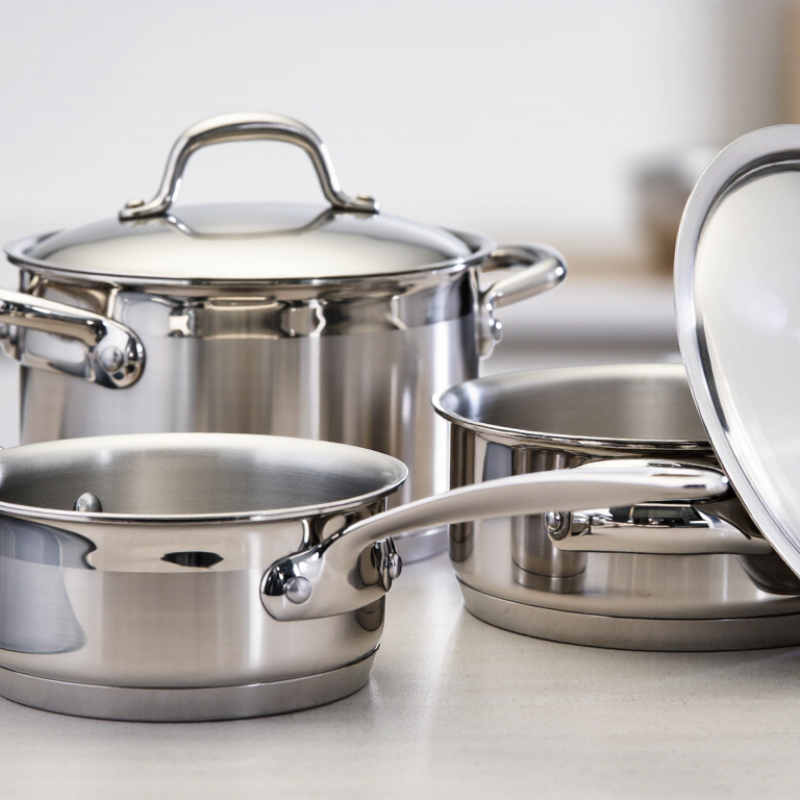
How to Choose a Stainless Steel Saucepan for Wholesale?

Define Wholesale Requirements for Stainless Steel Saucepans

Defining wholesale requirements is the first practical step when choosing stainless steel saucepans. Start with the customer and usage scenario. A restaurant may need a 2.5-liter pan for sauces, while a household retailer may prefer 1.5-liter and 3-liter sizes. Record expected order volumes, target price, sales channels, and delivery schedules before discussing factory quotations.

Specify the construction in measurable terms. Request the steel grade, body thickness, base structure, handle material, lid fit, and internal capacity. A thick, bonded base usually improves heat distribution, but it can also increase weight and freight costs. Check compatibility with gas, electric, ceramic, and induction cookers. Ask for sample testing with water, milk, and thick sauces. Small details matter. A loose lid becomes a return problem.

Wholesale buyers should also define packaging and quality controls. Clarify carton strength, unit protection, labeling, barcode placement, and acceptable defect limits. Request inspection records, material documentation, and applicable food-contact compliance documents. We once treated polished surfaces as proof of quality; that was a weak assumption. Scratches may appear after packing, and handles can loosen during repeated heating. Set practical tests for both issues. Forecasts can be wrong, especially for new sizes. A smaller trial order may protect cash flow while revealing actual demand. Include replacement terms, lead times, and communication procedures in writing.

Compare Stainless Steel Grades, Layers, and Construction Quality

When choosing a stainless steel saucepan for wholesale, compare the grade before judging its shine. The steel grade affects corrosion resistance, durability, and customer satisfaction.

304 stainless steel is a common choice for food-contact cookware. It offers reliable corrosion resistance and practical cost control. 316 steel contains molybdenum, which improves resistance in salty or acidic environments. However, its higher price may not suit every market. 430 steel is magnetic and often used for exterior surfaces or induction compatibility. It usually provides less corrosion resistance than 304. Ask for material certificates rather than trusting labels alone.

Layers also shape cooking performance. A three-layer design commonly combines stainless steel with an aluminum core. Aluminum spreads heat quickly, while stainless steel supports durability and easier cleaning. More layers do not automatically mean better performance. Check the core thickness and whether it reaches the base and sidewalls. A thin core may create hot spots around the center. Poor bonding can cause separation after repeated heating and cooling. Look closely.

Construction details deserve practical testing. Examine rivets, welds, the lid fit, and the flatness of the base. Place a sample on a level surface before approving a large order. Heat it with water and inspect for uneven boiling, discoloration, or warping. Small flaws matter. A polished finish can hide weak joints, while a low price may reflect thinner material. Request food-contact documentation, corrosion test results, and clear quality tolerances. Suppliers should explain these details without vague promises.

How to Choose a Stainless Steel Saucepan for Wholesale? - Compare Stainless Steel Grades, Layers, and Construction Quality

Evaluation Dimension Austenitic 304 Stainless Steel Austenitic 316 Stainless Steel Ferritic 430 Stainless Steel Wholesale Buying Guidance
Typical chromium and nickel content Approximately 18% chromium and 8% or more nickel; exact limits depend on the applicable standard. Approximately 16–18% chromium, 10–14% nickel, and 2–3% molybdenum. Approximately 16–18% chromium with little or no nickel. Request a material certificate or mill test report rather than relying only on a grade label.
Corrosion resistance Very good for normal cooking, water, milk, vegetables, and general household use. Higher resistance to chlorides and salt exposure than 304, although it is not corrosion-proof. Good in mild indoor conditions, but generally less resistant to chloride-containing environments than 304 and 316. Choose 316 for demanding coastal, commercial, or high-salt applications; 304 is usually the practical general-purpose option.
Magnetic behavior Usually non-magnetic when annealed, but forming and cold working can create slight magnetism. Usually non-magnetic when annealed, with possible slight magnetism after forming. Magnetic because of its ferritic structure. For induction, verify the actual finished base or run an induction compatibility test; magnetic response alone does not confirm quality.
Thermal conductivity at room temperature Approximately 14–16 W/m·K. Approximately 14–16 W/m·K. Approximately 24–26 W/m·K; still much lower than aluminum or copper. Do not select a saucepan by steel grade alone; the aluminum or copper core has the greatest effect on heating performance.
Common multi-layer construction 3-ply or 5-ply construction with a stainless-steel cooking surface, aluminum heat-spreading core, and stainless-steel exterior. Usually used as the cooking surface or exterior in premium multi-layer cookware; the core may still be aluminum. Often used as an induction-compatible exterior or encapsulated base, with an aluminum core beneath the cooking surface. Confirm the layer sequence, core material, and effective core thickness in the technical specification.
Heat distribution Poor as a single layer; substantially improved when paired with an aluminum or copper core. Similar to 304 as a single layer; performance mainly depends on the core and construction. Better than 304 or 316 as a single steel layer, but still benefits from a conductive core. For sauces and custards, prioritize even heat distribution and low hot-spot risk over a thin steel wall.
Recommended layer options 3-ply: good balance of cost, responsiveness, and durability. 5-ply: greater stiffness and heat retention, usually at higher cost. Useful for premium cooking surfaces or harsh-use requirements; full 316 multi-layer construction may add cost without improving everyday heating. Suitable as an induction-ready exterior or base layer when combined with a suitable conductive core. Ask for a cross-section drawing or sample cut section if the layer count is a key selling point.
Base construction Fully clad body or impact-bonded encapsulated base. Fully clad body or specialized premium construction. Commonly used in an encapsulated induction base because it is magnetic. Check that the base is flat, securely bonded, free of gaps, and remains stable after repeated heating and cooling.
Wall and base thickness targets Typical retail and foodservice designs vary widely; a heavier body generally improves stiffness and durability. Often selected for material performance rather than thickness alone. Thickness varies by design; a magnetic base does not necessarily indicate a heavy or durable pan. Set measurable tolerances with the supplier, such as body thickness, base thickness, weight, and allowable deformation.
Cooking surface finish Smooth polished or satin finish; a smoother surface is easier to clean but can show scratches more readily. Can be polished or satin finished; the alloy provides corrosion resistance, not non-stick performance. Usually polished or satin finished; surface quality depends strongly on grinding and polishing control. Inspect for pinholes, deep scratches, discoloration, sharp edges, and inconsistent polishing under strong light.
Rim and pouring design Rolled or reinforced rim helps resist deformation and supports cleaner pouring. Same design principles apply; material grade does not replace proper rim forming. Requires controlled forming to avoid burrs and uneven edges. Test pouring from both sides and inspect the rim for sharpness, drips, warping, and weld marks.
Handle construction Welded handles offer a smooth interior; riveted handles provide a visible mechanical connection when properly installed. Handle reliability depends more on attachment design and testing than on using 316 steel. Requires adequate weld or rivet strength and corrosion protection at the attachment area. Check handle alignment, movement, weld penetration or rivet seating, insulation, and load-bearing performance.
Induction compatibility Requires a magnetic exterior layer or bonded induction base; the cooking surface itself may remain non-magnetic. Requires a magnetic exterior layer or bonded induction base. Naturally magnetic and commonly used for induction-compatible bases. Test on the intended induction range and specify minimum heating response and base flatness requirements.
Best wholesale positioning Mainstream household, hospitality, and general foodservice cookware. Premium, coastal, professional, or high-salt-use applications where added corrosion resistance is justified. Value-oriented induction cookware and exterior/base components. Match the specification to the target price point, cooking environment, warranty expectations, and required certifications.
Key quality-control checks before ordering Verify alloy documentation, dimensions, weight, layer construction, base flatness, induction performance, heat distribution, handle strength, rim quality, surface finish, dishwasher or care claims, packaging protection, and batch consistency. Approve a pre-production sample and define acceptable quality limits before mass production.

Note: Stainless steel composition and thickness may vary by manufacturing standard and product specification. Confirm the applicable standard, test method, and certification requirements for the destination market.

Evaluate Size, Capacity, Handles, Lids, and Cooking Compatibility

How to Choose a Stainless Steel Saucepan for Wholesale?

Size and capacity should match the cooking habits of your target market. A 1.5-liter saucepan suits sauces, porridge, and single servings. Larger 3-liter models support family meals and small catering tasks. Check the internal depth, not only the stated volume. A narrow base may reduce heating efficiency. During product checks, fill each pan with water and measure its usable capacity. Small differences can affect customer satisfaction.

Handles deserve practical testing. They should feel balanced, stay secure, and remain comfortable with a full pan. Riveted handles often provide dependable strength, but inspect every joint for sharp edges or movement. A helper handle is valuable on larger sizes. It improves control during pouring. Lids should fit closely without trapping excessive steam. Tempered glass allows users to monitor food, while stainless steel offers stronger impact resistance. Neither option is perfect.

Cooking compatibility also influences wholesale appeal. A fully magnetic base is generally needed for induction cooktops. Confirm compatibility with gas, electric, ceramic, and induction surfaces. The base should sit flat and heat evenly. Test several samples because polishing can hide uneven contact. I once overlooked lid-knob heat resistance during evaluation. That mistake was minor, but it changed the inspection checklist. Packaging should protect handles and lids from scratches during shipment. Ask for material specifications, thickness data, and test records before placing a large order.

Check Supplier Standards, Customization Options, and Certifications

How to Choose a Stainless Steel Saucepan for Wholesale?

Supplier standards should be checked before discussing price. Ask for the steel grade, thickness, welding method, and polishing process. Reliable suppliers can explain each point clearly. A saucepan with a thin base may heat quickly but can warp during repeated use. Request production samples, not only catalog photos. Inspect the rim, handle joints, lid fit, and interior finish under bright light. Small scratches often reveal weak polishing control.

Customization can support different markets and cooking habits. You might request a thicker encapsulated base, measurement marks, a glass lid, or a modified handle. Confirm the drawing, material specification, packaging method, and minimum order quantity in writing. Ask for a pre-production sample. It saves trouble later. However, customization is not always better. A complex handle may increase cost and create cleaning problems. I have seen buyers focus on appearance and overlook carton strength. That mistake can damage units before customers use them.

Certifications deserve careful verification. Request current certificates, laboratory reports, and test scopes related to food-contact materials. Check whether the documents match the exact steel grade and finished product. Factory audits can also reveal storage conditions, calibration records, and batch traceability. A certificate alone proves little if the production line has changed. Ask how failed inspections are recorded and corrected. The answer may be uncomfortable, but it is useful. Keep retained samples from each shipment when possible. Wholesale reliability depends on consistent batches, not one impressive sample.

Assess Pricing, Minimum Orders, Packaging, and Delivery Terms

How to Choose a Stainless Steel Saucepan for Wholesale?

Wholesale saucepan buying should begin with the complete landed cost, not the unit price. Ask for pricing at several quantities, such as 100, 500, and 1,000 pieces. Confirm whether lids, handles, polishing, cartons, and inspection fees are included. A low quote may exclude export packing or inner boxes. I once compared two offers and missed a tooling charge. The cheaper option was not cheaper.

Minimum order quantities need careful discussion. A supplier may require 500 saucepans per size, while mixed sizes may need 2,000 pieces. Request a written MOQ schedule. Also ask about sample charges, repeat-order quantities, and production lead times. Smaller trial orders can reduce risk. They may increase the unit cost, though. That trade-off deserves calculation.

Packaging affects both protection and delivery expense. Check carton strength, separators, moisture protection, and drop-test procedures. A saucepan with a loose lid can arrive scratched or dented. Request package dimensions and gross weight before booking freight. Delivery terms must state the shipping point, transport method, estimated production time, and responsibility for import procedures. Clarify whether the quote covers delivery to your warehouse or only to a port. Freight estimates can change. My early planning was too optimistic because I ignored seasonal congestion. Ask for inspection photos and tracking documents before final payment, but keep every agreed detail in writing.

How to Choose a Stainless Steel Saucepan for Wholesale?

Indicative landed-cost structure for a 2 L stainless steel saucepan wholesale order.

Unit Price $6.80 per saucepan
Minimum Order 500 pieces per order
Retail Packaging $0.45 per unit
Delivery Timeline 43 days 25 production + 18 transit

The estimated product, packaging, inland freight, and ocean freight costs total approximately $8.35 per unit, excluding import duties, taxes, inspection fees, and destination charges. Before placing an order, confirm the stainless steel grade, thickness, handle construction, packaging standard, MOQ, Incoterm, production schedule, and delivery route in writing.

Illustrative wholesale planning figures; actual quotations vary by specification, order volume, destination, and delivery terms.

FAQS

What saucepan sizes suit different cooking needs?

A 1.5-liter pan suits sauces, porridge, and single servings. A 3-liter pan supports family meals or small catering tasks. Check internal depth too. Stated capacity may overestimate usable space.

How can buyers verify a saucepan’s actual capacity?

Fill each sample with water and measure the usable volume. Compare the result with the listed capacity. Small differences can disappoint customers. Do not rely on labels alone.

What should wholesalers inspect on saucepan handles?

Handles should feel balanced with a full pan. Test for movement, sharp edges, and weak joints. Riveted handles often provide strong support. Larger pans may need a helper handle.

Which lid material is more suitable?

Tempered glass lets users watch food while cooking. Stainless steel usually offers better impact resistance. Neither option is perfect. Check the fit and steam release carefully.

How do buyers confirm cooking surface compatibility?

Test the pan on gas, electric, ceramic, and induction surfaces. Induction generally requires a fully magnetic base. The base should sit flat and heat evenly. Polishing can hide uneven contact.

What costs should a wholesale quotation include?

Compare the complete landed cost, not only the unit price. Confirm prices at 100, 500, and 1,000 pieces. Ask whether lids, handles, cartons, inspection, and tooling are included. A low quote may exclude important charges.

How should wholesalers evaluate minimum order quantities?

Request a written MOQ schedule for each size and mixed-size order. Ask about sample fees, repeat orders, and production lead times. A small trial order lowers risk. It may raise the unit cost, though.

What packaging and delivery details require confirmation?

Check carton strength, separators, moisture protection, and drop-test procedures. Ask for package dimensions and gross weight. Confirm the shipping point, transport method, production time, and import responsibilities. Seasonal congestion can delay delivery. My early planning was too optimistic.

Conclusion

Choosing the right Stainless Steel Saucepan for wholesale requires a clear understanding of your target market, sales channels, and expected order volume. Start by defining the preferred sizes, applications, price range, and quality level. Then compare stainless steel grades, multi-layer construction, base thickness, heat distribution, and overall durability. These factors affect cooking performance, appearance, product lifespan, and customer satisfaction.

You should also evaluate capacity, handle comfort, lid design, weight, and compatibility with gas, electric, ceramic, or induction cookers. Before placing an order, review the supplier’s production standards, quality control procedures, customization services, and relevant certifications. Finally, compare unit pricing, minimum order quantities, packaging protection, payment conditions, lead times, and delivery terms. A reliable wholesale decision balances product quality, practical features, customization flexibility, and total purchasing cost, helping you build a competitive product range while reducing quality and supply risks.

Amelia Bennett

Amelia Bennett

Amelia Bennett is a professional marketing specialist with a strong understanding of product strategy, customer needs, and effective digital communication. She regularly contributes expert articles to the company’s website, transforming complex product information into clear, practical, and......