Parin SteelsStainless Steel Kitchenware Manufacturer
Choosing the right Stainless Steel Kitchen Container is more than comparing prices or polished finishes. The container must protect food, resist corrosion, and fit real kitchen routines. A lid that leaks in a crowded refrigerator quickly becomes a daily frustration.
Industry research supports this practical focus. Grand View Research’s Food Storage Container Market analysis identifies durability, reusability, and food-safety expectations as important market drivers. IMARC Group also reports continued demand for reusable food storage products, influenced by sustainability concerns and changing household habits. These reports describe broad market movement, not a guarantee for every product.
Material quality deserves careful attention. Food-contact professionals commonly distinguish 304 stainless steel from lower-grade alloys because 304 offers strong corrosion resistance for ordinary kitchen use. However, grade alone does not prove quality. Welding, surface finishing, lid materials, and manufacturing controls matter too. Check the product specification, food-contact documentation, and care instructions.
Small details matter. A thick rim feels stable when pouring soup. A silicone seal should sit evenly, without gaps or a strong chemical odor. The base should remain flat on a wet countertop. These simple checks often reveal more than attractive packaging.
The perfect container does not exist. Some models keep food secure but become heavy when filled. Others stack neatly but have narrow openings that are difficult to clean. This is where many buying guides oversimplify the decision. The best choice depends on meal size, storage space, cleaning habits, and expected temperature use. In the following guide, these factors will be examined with practical tests, recognized standards, and realistic limitations.
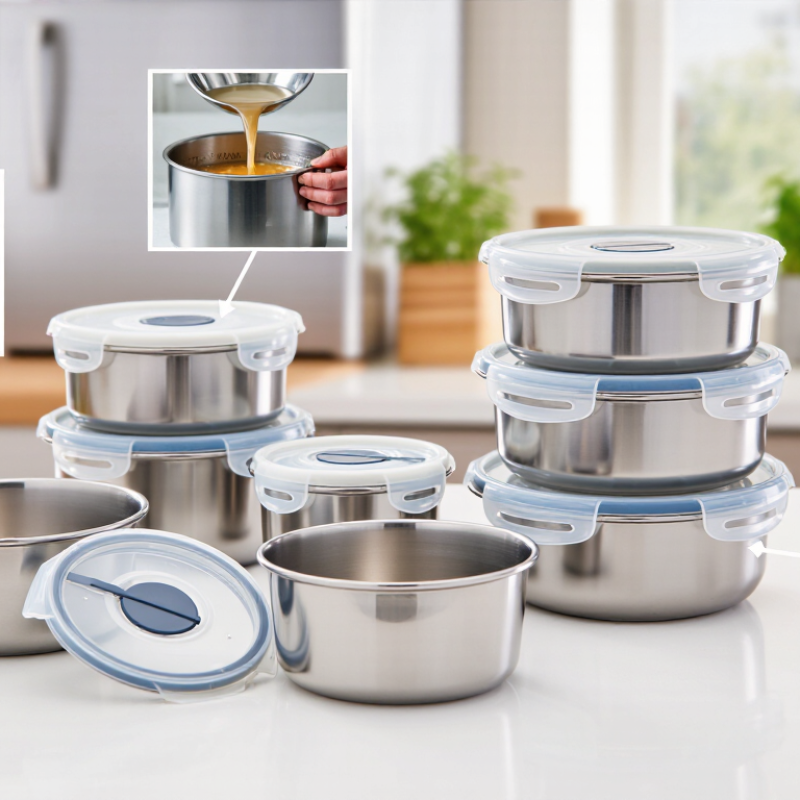
Choosing a stainless steel kitchen container begins with the food, not the cabinet. List what you store each week: cooked rice, leafy vegetables, sauces, dry grains, or leftovers. Each item needs a different barrier. Moist foods need tight lids and rounded interiors that clean easily. Dry goods need stackable shapes and enough headspace for scooping.
UNEP’s Food Waste Index Report 2024 estimated 1.05 billion tonnes of food were wasted in 2022. Households generated 60% of that waste. This makes portion planning and visible storage practical, not merely attractive. Choose sizes that match actual meals. A two-liter container may suit soup, but it wastes space for one serving.
Use temperature and handling as selection tests. The FDA Food Code 2022 identifies 41°F (5°C) or below as the cold-holding limit for many potentially hazardous foods. That is a safety reference, not permission to ignore local requirements. Select food-contact stainless steel, secure seals, and lids without cracks. Check whether the container is dishwasher-safe, freezer-compatible, and resistant to acidic foods. Do not assume every shiny surface performs equally. Poorly finished seams can trap residue. An honest drawback matters: metal blocks microwave use and hides food color. For leftovers, add a date label and leave room for expansion. Test one container for a week. Notice leaks, odors, stacking stability, and whether the lid slows daily work.
| Storage Need | Recommended Container Type | Typical Capacity | Suitable Stainless Steel | Best Uses | Important Features | Selection Guidance |
|---|---|---|---|---|---|---|
| Dry Pantry Staples | Stackable canister with a fitted lid | 0.8–2.5 L | Food-contact stainless steel, commonly 304 grade | Rice, flour, oats, pasta, sugar, and dried beans | Wide opening, airtight or gasketed lid, transparent viewing panel | Choose a capacity that matches the package size and allows easy scooping without overfilling. |
| Spices and Seasonings | Small jar or compartment organizer | 100–300 ml per container | 304 stainless steel for general kitchen use | Salt, pepper, herbs, spice blends, and seasoning powders | Small footprint, shaker or sprinkle opening, secure screw or clip lid | Use opaque or light-blocking containers for light-sensitive herbs and spices. |
| Refrigerated Leftovers | Rectangular food storage box with a sealed lid | 0.6–2.0 L | 304 stainless steel; 316 may be useful in more corrosive environments | Cooked vegetables, meat, grains, sauces, and prepared meals | Leak-resistant seal, nesting shape, rounded interior corners | Select several matching sizes to reduce unused refrigerator space and simplify stacking. |
| Meal Preparation | Mixing or prep bowl with a stable base | 1.5–5.0 L | 304 stainless steel | Washing produce, mixing ingredients, marinating, and whisking | Non-slip base, rolled rim, measurement markings, comfortable handling | A deeper bowl helps prevent splashing, while a broad base improves stability during mixing. |
| Freezer Storage | Freezer-safe container with a flat, stackable profile | 0.5–1.5 L | 304 stainless steel with a durable, temperature-resistant lid | Frozen meals, chopped ingredients, stock, and portioned food | Rigid walls, leak-resistant lid, headspace allowance, clear capacity markings | Leave expansion space for liquids and confirm that the lid and seal are rated for freezing temperatures. |
| Lunch and Transport | Compact tiffin-style container or divided lunch box | 0.5–1.2 L | 304 stainless steel | Sandwiches, fruit, salads, snacks, and packed meals | Secure closure, separate compartments, lightweight construction | For liquid foods, prioritize a tested leak-resistant seal rather than relying only on a snap-fit lid. |
| Bulk Food Organization | Large storage bin with a reinforced lid | 3–8 L | 304 stainless steel; thicker walls improve rigidity | Large quantities of grains, pet food, baking ingredients, and snacks | Strong handles, wide opening, stackable lid, easy-to-clean surfaces | Check the filled weight before choosing a large container with handles or a pull-out design. |
| Hot Food Holding | Insulated stainless steel food container | 0.5–2.0 L | 304 stainless steel inner wall with vacuum insulation | Soups, stews, porridge, cooked grains, and hot beverages | Double-wall insulation, insulated lid, wide mouth, pressure-safe design | Preheating with hot water can improve heat retention; follow the product’s temperature and care instructions. |
| Cleaning and Maintenance | Dishwasher-compatible container with removable seals | Any practical size | 304 stainless steel is generally suitable for routine food storage | Frequent daily storage and meal preparation | Few crevices, removable gasket, smooth welds, corrosion-resistant finish | Verify dishwasher guidance for the lid, gasket, coating, and exterior components because care requirements may differ. |
Match the container to real portions. A two-liter container wastes space for one serving. Choose smaller sizes for rice, sauces, and leftovers. Leave room for expansion.
Moist foods need secure seals. Soup, cooked rice, and leafy vegetables can leak or dry out. Rounded interiors help remove residue. Check the lid for cracks.
Grade 304 suits most kitchens. It resists moisture, salt, and everyday acids. Grade 316 may suit salty foods or humid rooms. Grade 430 needs more careful drying.
No. Shine can mislead. Inspect seams, rims, and welds with a fingertip. Rough areas may trap sauce or food particles. A dull container can still perform well.
Food-contact steel should be smooth, corrosion-resistant, and easy to clean. Acidic sauces may increase metal migration. Wash them promptly and dry the container. Avoid unknown coatings.
Usually, no. Metal blocks microwave use. Transfer food to a suitable microwave-safe dish. This extra step can slow busy mornings.
Keep many potentially hazardous foods at 41°F or below. Use a date label. Seal the container and leave expansion space. Local food rules may differ.
Test one container for a week. Notice leaks, odors, stacking stability, and lid performance. Check dishwasher and freezer compatibility. My earlier mirror-finish test was weak. Daily handling reveals more.
Choosing the best Stainless Steel Kitchen Container starts with understanding your storage needs, such as meal preparation, leftovers, dry ingredients, or food transport. Consider the container’s stainless steel grade, safety features, corrosion resistance, and durability to ensure it can handle regular kitchen use. The right size, shape, and capacity should match your available storage space and the types of food you usually store.
Lids and seals are equally important because they help prevent spills, preserve freshness, and support convenient transportation. Stackable designs can save cabinet or refrigerator space, while smooth interiors and removable parts make cleaning easier. Before purchasing, check the overall construction, maintenance requirements, and long-term value rather than focusing only on the initial price. A well-designed container should be safe, practical, durable, easy to clean, and suitable for your everyday cooking and storage habits.