Choosing a Stainless Steel Kitchen Canister in 2026 involves more than comparing polished finishes and attractive labels. A reliable container should protect dry ingredients from moisture, odors, light, and everyday kitchen mess. Flour, coffee, rice, and spices each behave differently, so capacity and sealing performance matter. A beautiful canister can still disappoint if its lid loosens or its gasket absorbs strong smells.
I have learned that small details often decide long-term satisfaction. Check whether the manufacturer identifies the steel grade, such as 304 stainless steel, and explains its food-contact suitability. Product documentation matters more than vague claims like “premium quality.” Look closely at the lid hinge, silicone seal, interior seams, and base stability. These areas collect crumbs or water when cleaning is rushed. They deserve attention.
Ease of maintenance matters.
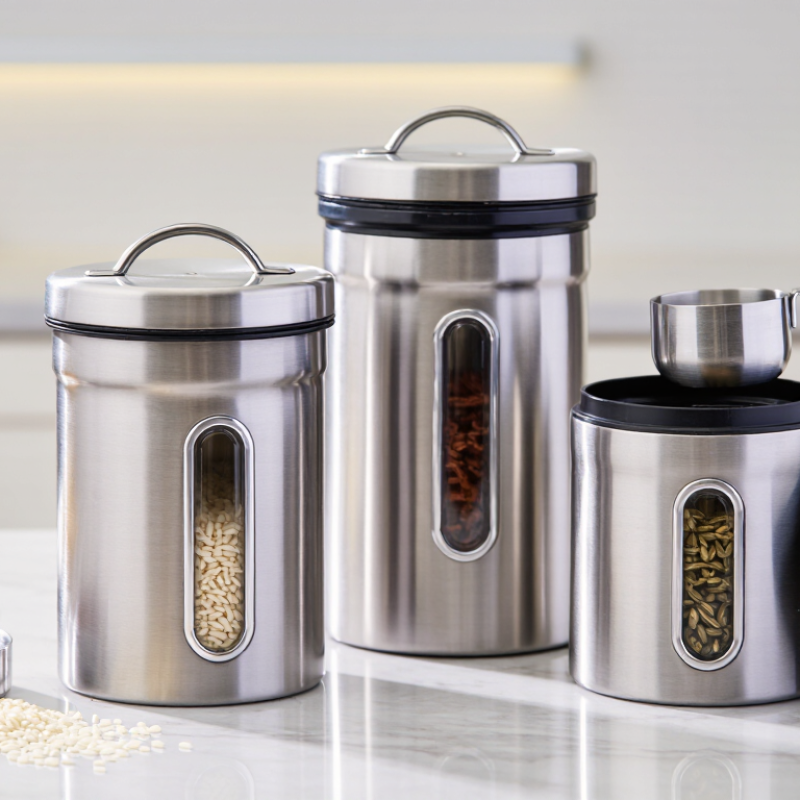
Choose a wide opening if you regularly use measuring cups. Select stackable shapes when cabinet space is limited. Transparent windows may help you monitor supplies, but they can complicate cleaning and may scratch over time. A canister should also feel balanced when full, not merely impressive when empty. I once underestimated lid clearance and discovered that a tall container could not fit beneath my shelf. That mistake was avoidable.
This guide compares materials, sizes, closures, cleaning requirements, and practical safety considerations. It also explains how to assess manufacturer evidence, warranty terms, and customer feedback without trusting every marketing phrase. No single design suits every kitchen. The best choice is the one that matches your ingredients, habits, storage space, and willingness to maintain it.
2026 How to Choose a Stainless Steel Kitchen Canister?
A dependable canister begins with verified 304 stainless steel. ASTM A240/A240M lists 304 steel with approximately 18–20% chromium and 8–10.5% nickel. These elements create corrosion resistance and support long-term kitchen use. Nickel also helps maintain a stable, non-reactive surface around dry foods. Still, numbers need checking. A polished finish alone proves nothing.
The FDA Food Code 2022 recommends smooth, durable, corrosion-resistant, and nonabsorbent food-contact surfaces. Look for these qualities inside the lid, rim, and container walls. I usually inspect the seam first. Rough welding can trap flour dust or moisture. A laser marking, material certificate, or supplier test report is more useful than vague words like “premium steel.” World Stainless reports that global stainless crude steel production reached about 58.4 million tonnes in 2023, showing the material’s broad industrial use, but production volume does not guarantee every canister is genuine.
Tips: Hold the canister under bright light. Check for rust spots, sharp edges, and uneven seams. Ask whether the steel is 304, not merely “stainless.” Test the lid seal with a small amount of rice. It should close evenly. Avoid storing wet foods for long periods. That is where my judgment can fail; 304 resists corrosion, but it is not corrosion-proof.
Identify 304 stainless steel by its typical chromium and nickel composition for food storage applications.
How to read the chart: Type 304 stainless steel commonly contains 18–20% chromium and 8–10.5% nickel by mass. Chromium supports corrosion resistance, while nickel improves toughness and stability. The remaining composition is primarily iron. For reliable verification, check the material certificate or grade marking rather than relying on appearance alone.
Reference: Typical ASTM A240 Type 304 chemical composition limits.
2026 How to Choose a Stainless Steel Kitchen Canister?
When choosing a stainless steel kitchen canister, check the steel grade before admiring its finish. Grade 316 contains about 2–3% molybdenum. This alloying element improves resistance to pitting caused by salt, acidic foods, and humid kitchen air. It suits ingredients such as sea salt, pickles, coffee, and tomato-based powders. The benefit is practical. Tiny scratches and salty residue are less likely to trigger localized corrosion. However, 316 stainless steel is resistant, not invincible. Long exposure to brine can still stain the surface.
Tips: Ask for clear material information from the seller. Check the lid rim, welds, and inner corners carefully. These areas collect moisture and food particles. A tight silicone seal helps, but it should remain removable for cleaning. Do not rely only on a fridge magnet. Magnetism can vary after forming and does not confirm the steel grade.
A polished canister may look premium, yet appearance proves little. I would prioritize documented 316 steel, a smooth interior, and a stable lid. Thin walls can dent easily. Poorly finished edges may trap residue. Wash salt dust away before storage, then dry the canister fully. Acidic ingredients should not sit against wet metal for weeks. That detail is easy to overlook. Also, inspect the lid after repeated use. A good canister protects food, but careless cleaning can weaken its advantages.
2026 How to Choose a Stainless Steel Kitchen Canister?
A stainless steel canister should be judged by food-contact evidence, not its polished surface. Under FDA 21 CFR requirements, every food-contact component must be suitable for its intended use. This includes the steel, coatings, seals, adhesives, and printed markings. Ask for the exact material grade and supplier documentation. A general “food safe” statement is too weak.
The EU framework is different but equally important. Regulation (EC) No. 1935/2004 requires food-contact materials to avoid transferring harmful substances, changing food composition, or damaging its taste and smell. The canister should also be produced under appropriate good manufacturing practices. Check whether testing covers acidic foods, salty ingredients, heat, and repeated washing. A lid gasket can fail before the metal does.
In practical supplier audits, I look for a Declaration of Compliance, migration test results, batch traceability, and clear intended-use limits. FDA 21 CFR compliance is not a single universal certificate for every canister. The relevant evidence depends on construction and use conditions. EU documentation should identify the material, test method, and responsible manufacturer. Paperwork can still be incomplete. Request test reports from an accredited laboratory, but review their scope carefully. “Stainless steel” alone proves very little. Inspect welds, seams, and scratched surfaces before purchase. Good documentation reduces risk, yet independent verification remains worthwhile.
| Verification Dimension | What to Check | FDA-Oriented Requirement | EU-Oriented Requirement | Evidence to Request |
|---|---|---|---|---|
| Regulatory scope | Confirm that the canister, lid, liner, gasket, coating, printing ink and adhesive are all evaluated as food-contact components. | Essential Food-contact articles must comply with applicable FDA food-contact requirements, including the general safety principle in 21 CFR 174.5. Compliance is use-specific and is not established by the phrase “stainless steel” alone. |
Essential Materials must comply with the framework requirements of Regulation (EC) No 1935/2004 and be manufactured under Regulation (EC) No 2023/2006 on good manufacturing practice. |
Material compliance statement covering every food-contact part, intended food types, temperature range and contact duration. |
| Stainless steel grade | Prefer a clearly identified grade, such as AISI 304/304L for general kitchen use or AISI 316/316L for higher chloride exposure. | Recommended The grade should be supported by composition or mill documentation. FDA compliance cannot be inferred from the grade designation alone. |
Recommended Use a documented alloy composition and assess metal-ion release under the actual intended conditions. EU requirements may also depend on applicable national provisions because metal-specific rules are not fully harmonized across the EU. |
Mill test certificate or material certificate stating grade, chemical composition and batch/heat number. |
| Surface condition | Choose a smooth, cleanable, non-absorbent interior without pits, rust, flaking, exposed weld defects or residues. | Essential For reusable food-contact equipment, the FDA Food Code describes food-contact surfaces as smooth, durable, corrosion-resistant, nonabsorbent and easily cleanable. |
Essential The article must not transfer substances in quantities that could endanger health, create unacceptable changes in food composition or adversely affect taste or odour under normal use. |
Finished-product inspection report, photographs, surface-finish specification and cleaning assessment. |
| Metal migration | Assess potential release of nickel, chromium and other relevant metals, especially for acidic, salty or wet foods. | Essential Use a documented risk assessment and suitable extraction or migration testing for the intended food-contact conditions. Do not treat “304” or “316” as a universal FDA migration limit. |
Essential Test or otherwise justify metal release using conditions representative of intended use and applicable EU or Member State requirements. Nickel release can be particularly relevant for sensitive users. |
Independent laboratory report with alloy identification, test medium, temperature, time, detection limits and results in mg/kg or mg/dm². |
| Food type and acidity | Define whether the canister will hold dry foods only or also coffee, tea, spices, oils, sauces, fruit, vinegar or other acidic/salty foods. | Essential Intended use must be stated because food-contact safety depends on the food, temperature, contact time and surface area. |
Essential Migration assessment must represent the most demanding reasonably foreseeable food-contact use. Acidic and salty foods generally require more conservative evaluation than dry foods. |
Intended-use matrix listing food categories, pH range, contact time, temperature and storage conditions. |
| Temperature and use cycle | Check room-temperature storage, hot filling, dishwasher exposure, freezer use and repeated opening/closing cycles. | Essential Testing and safety justification should cover the highest foreseeable temperature and repeated-use conditions. Coatings and polymeric parts may require separate FDA assessment. |
Essential Use conditions must reflect foreseeable contact duration and temperature. Repeated washing and thermal cycling should be considered where the product is reusable. |
Use-condition specification, dishwasher-cycle report, thermal-cycle report and testing plan based on worst-case use. |
| Lid, gasket and seal | Inspect silicone, elastomer, plastic, adhesive and coating components that may contact food or condensate. | Essential Each non-metal component needs its own applicable FDA authorization or compliance basis. A stainless steel body does not cover the lid gasket or polymer liner. |
Essential All food-contact components must comply with Regulation (EC) No 1935/2004; plastic components may also require compliance with Regulation (EU) No 10/2011 where applicable. |
Separate declarations or compliance statements for gasket, liner, coating, ink and adhesive, including temperature and food simulant limits. |
| Odour, taste and colour transfer | Check for metallic taste, solvent odour, lubricant residues, coating odour and colour transfer after washing or heat exposure. | Verify Evaluate extractables and sensory impact where coatings, inks, adhesives or elastomers are present. |
Essential Regulation (EC) No 1935/2004 prohibits unacceptable changes in the composition or organoleptic properties of food. |
Sensory evaluation, extractables report and production-cleanliness declaration. |
| Traceability and batch control | Ensure the product can be traced from finished canister to steel coil, gasket compound, coating batch and production date. | Recommended Maintain supplier specifications, test records and change-control documentation supporting the compliance determination. |
Essential Good manufacturing practice requires documented quality systems and traceability suitable for food-contact materials. |
Lot code, supplier list, batch records, change-notification procedure and retained test samples. |
| Labelling and instructions | Provide cleaning instructions, food-contact suitability, maximum temperature, use limitations and warnings against unsuitable chemicals. | Recommended Instructions should prevent reasonably foreseeable misuse, particularly with abrasive cleaners, bleach and high heat. |
Essential Food-contact articles should be adequately labelled or accompanied by instructions where needed for safe and appropriate use. |
Final artwork, care instructions, dishwasher/freezer claims and food-contact symbol or wording where legally appropriate. |
| Declaration package | Review whether the supplier’s documents match the exact model, material construction and intended use. | Essential Request a signed compliance statement identifying applicable FDA provisions and any limitations or conditions of use. |
Essential Request a Declaration of Compliance where required or appropriate, supported by traceability, testing and technical documentation. |
Signed declaration, technical file index, laboratory reports, specifications and revision-controlled product drawings. |
Choosing a stainless steel kitchen canister starts with its seal, not its polished surface. A reliable lid should use food-contact silicone with a clearly stated grade. Check the material description, temperature range, and independent safety documentation. Vague phrases such as “premium rubber” provide little evidence. Look closely at the gasket. It should feel smooth, flexible, and free from cracks or strong chemical odors.
Leak-test results deserve equal attention. A useful test should explain the filling level, liquid temperature, test duration, and lid position. For example, a canister may be filled with water, sealed, inverted for several minutes, and gently shaken. Some tests also repeat opening and closing cycles to examine long-term compression. Details matter. “Leak-proof” alone is not a test result.
I inspect the rim after testing. A narrow, even gasket contact usually seals better than a loose ring. I also test warm water because heat can soften silicone and reveal weak points. Cold storage matters too. However, household testing has limits, and my results may differ from laboratory findings. I once trusted a tight first seal, but it loosened after repeated washing. That experience changed my checklist. Choose documented silicone grade and measurable leak-test results, then inspect the seal regularly for flattening or damage.
Choosing a stainless steel kitchen canister starts with capacity, not appearance. Measure the shelf height, opening space, and the amount of food used weekly. A 1.5-liter canister may suit coffee, while flour often needs more room. Overfilling creates spills and weakens hygiene control. Leave a small air gap.
ISO 22000 hygiene principles emphasize hazard control, traceability, and clean handling. Choose a wide opening so your hand or scoop can reach every corner. Smooth welds and rounded edges reduce places where food residue can collect.
A removable silicone seal helps cleaning, but inspect it for cracks and trapped moisture. Dry every part completely before refilling.
Cleaning should be practical, not theoretical. I prefer canisters that tolerate warm water, mild detergent, and repeated wiping without losing their finish. Avoid deep scratches, as they can hold residue. Check whether the lid closes firmly but opens without touching the food-contact surface. That small detail matters during busy cooking.
Durability also affects food safety. Thick steel resists dents, yet heavy construction may become inconvenient on high shelves. Some containers look strong but have loose hinges after months of use. I have learned to test the lid several times before trusting it. No canister stays hygienic through neglect. Regular inspection, dry storage, and clear date labels still depend on the user.
It contains about 2–3% molybdenum. This improves resistance to salt, acids, and humid air. It is resistant, not invincible.
It can hold sea salt, pickles, coffee, and tomato-based powders. Wash away salty dust before storage. Keep the interior dry.
No. Appearance proves little. Request the exact steel grade and supplier documents. Check the interior, welds, lid rim, and corners.
No. Magnetism can change after forming. A magnet is only a rough clue, not reliable proof.
Ask for a Declaration of Compliance, migration tests, and batch traceability. Testing should cover salt, acidic foods, heat, and repeated washing. Paperwork may still be incomplete.
Choose a wide opening, smooth welds, and rounded edges. These details make residue easier to remove. Small gaps matter.
Measure shelf height, opening space, and weekly food use. A 1.5-liter container may suit coffee. Flour usually needs more room.
The silicone seal should fit firmly and remain removable. Inspect it for cracks and trapped moisture. Dry every part completely.
Use warm water, mild detergent, and repeated wiping. Avoid deep scratches and long contact with wet acidic foods. I sometimes underestimate drying time.
Thicker steel resists dents, but it may feel heavy on high shelves. Test the lid several times. A sturdy-looking hinge can still loosen later.
Choosing the right Stainless Steel Kitchen Canister requires more than comparing appearance and price. For everyday food storage, look for 304 stainless steel, typically containing about 18% chromium and 8% nickel, which offers good corrosion resistance and durability. If the canister will hold salty, acidic, or highly seasoned ingredients, 316 stainless steel may be a better option because its 2–3% molybdenum content provides enhanced resistance to corrosion. Always verify that the product is suitable for food contact and complies with FDA 21 CFR and EU 1935/2004 requirements.
A reliable canister should also have an airtight seal made from food-grade silicone. Check the silicone grade, sealing design, and available leak-test results rather than relying only on marketing claims. Finally, choose a capacity that suits your ingredients and storage space, with a wide opening for easy filling and cleaning. Smooth, durable surfaces and resistance to repeated washing are important for long-term hygiene. Applying ISO 22000 hygiene principles can help you evaluate cleanliness, material safety, and practical daily use.