
Parin SteelsStainless Steel Kitchenware Manufacturer
Precision-engineered cookware for global distributors, commercial kitchens, and high-end retail brands. All models conform to European Union CE directives and international food safety criteria.
Navigating global supply chain regulations, metallurgical standards, and food safety directives for commercial cookware importers.
In the contemporary global trade ecosystem, procuring commercial and retail frying pans is no longer strictly a matter of price per unit. International retail chains, hospitality conglomerates (HoReCa), and cookware importers operate under stringent regulatory mandates across the European Economic Area (EEA), North America, and the Middle East. As an established CE Certified Frying Pan Manufacturer & Exporter, our manufacturing infrastructure bridges raw material science with automated precision engineering to deliver products that withstand high-stress commercial kitchens while complying with rigorous international directives.
Strategic Procurement Insight: The CE mark on commercial cookware serves as a legally binding declaration of compliance with European Union safety, health, and environmental protection standards under EN 12983-1 (Cookware for domestic use on stove top) and Regulation (EC) No 1935/2004 for materials intended to come into contact with food.
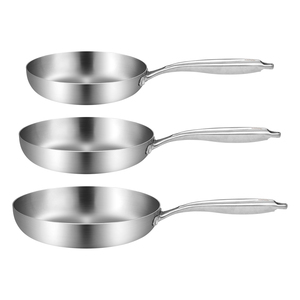
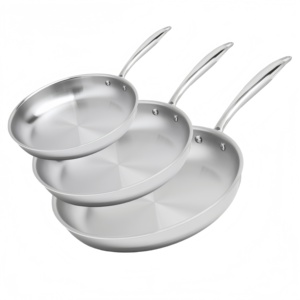
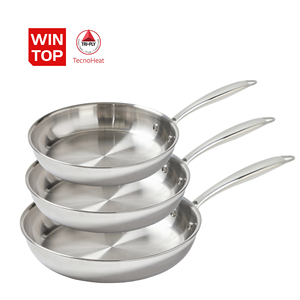
Every frying pan leaving our production lines undergoes systematic stress verification, including mechanical handle strength tests (torque and bending loads exceeding 100 Nm), thermal shock resistance profiling, and surface migration testing. By employing advanced metallurgical bonding techniques—such as tri-ply impact-bonded encapsulation—we manufacture pans that prevent base distortion, eliminate thermal hot spots, and enhance energy conversion across modern induction hobs.
Exporting to regulated markets demands multi-jurisdictional compliance. The table below outlines the mandatory certification benchmarks embedded within our production management framework:
| Regulatory Directive / Standard | Geographic Region | Technical Testing Requirement | Manufacturing Verification Method |
|---|---|---|---|
| CE / EN 12983-1 | European Union / EEA | Handle fatigue, thermal hazard prevention, stability & base flatness. | Cyclic load testing & laser profilometer base planarity scanning. |
| Regulation (EC) No 1935/2004 | Europe / International | Overall chemical migration limits (heavy metals, nickel, chromium release). | Inductively Coupled Plasma Mass Spectrometry (ICP-MS) raw batch test. |
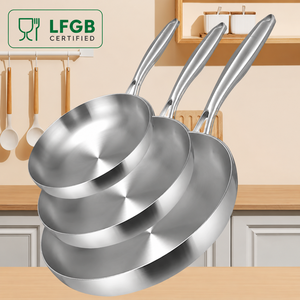
| LFGB § 30 & 31 | Germany / EU Premium | Sensory testing, extractable organic components, non-stick stability. | Acidic solution thermal boiling exposure & GC-MS analysis. |
| FDA 21 CFR 175.300 | United States | Resinous and polymeric food contact coatings compliance. | Solvent extraction (n-hexane, distilled water exposure). |
Key market transitions driving purchase decisions for wholesale buyers, brand owners, and procurement directors.
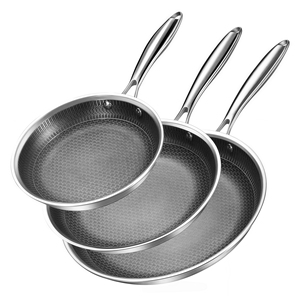
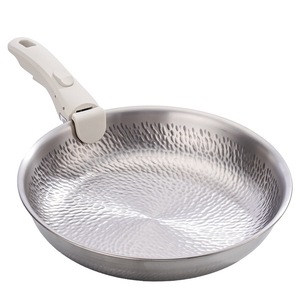
Global regulatory bodies (notably ECHA in Europe and state-level EPA bans in the US) are forcing a rapid shift away from fluorinated polymers (PTFE). Future-ready buyers are migrating towards Sol-Gel ceramic coatings and physically micro-etched stainless steel surfaces (laser honeycomb matrices) to ensure long-term market access without legal exposure.
With global commercial kitchens transitioning to high-frequency induction ranges to lower carbon footprints, procurement teams are specifying Tri-Ply (SS 304 + Aluminum + SS 430) and 5-Ply clad cookware. Magnetic SS 430 exterior bases deliver near 90%+ electromagnetic energy conversion, cutting kitchen energy costs dramatically.
Pure Titanium (Grade 1 & Grade 2) is emerging as the premier choice for health-conscious consumers and medical-grade food preparation. Titanium forms a permanent, self-healing oxide layer that prevents metal ion leaching, resists severe acid/salt corrosion, and eliminates the need for synthetic coatings.
How advanced manufacturing automation is reshaping product durability, heat dynamics, and commercial kitchen robotics.
Traditional non-stick coatings fail under metal utensil abrasion. Modern manufacturing solves this by applying high-precision fiber laser etching to cut a protective raised stainless steel honeycomb grid over a recessed ceramic non-stick valley. The raised stainless ridges absorb the friction of spatulas and whisks, allowing the non-stick structure to remain intact over thousands of commercial cooking cycles.
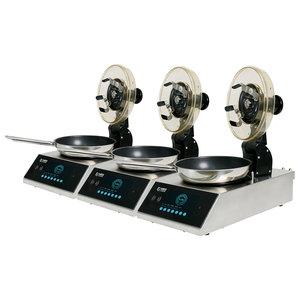
Rising labor costs in the HoReCa industry have accelerated the adoption of automated cooking equipment. Innovations such as the MEGCOOK M1 Commercial Cooking Robot (3520W) integrate high-power induction heating, automated multi-stage planetary stir-frying, and digital touchscreen recipe execution. This ensures recipe consistency, reduces oil smoke emissions, and scales output in high-volume commercial kitchens.
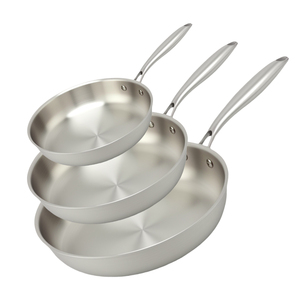
Standard single-layer stainless steel suffers from low thermal conductivity (~16 W/m·K), leading to localized scorching. Our tri-ply clad technology bonds an inner layer of food-grade SS 304 with an ultra-conductive pure aluminum core (~237 W/m·K) and an outer magnetic SS 430 skin. This multi-layered structure spreads heat laterally across the sidewalls within seconds, maintaining thermal equilibrium during intense searing.
Technical Superiority: Tri-ply construction reduces thermal response latency, allowing chefs to quickly alter pan temperatures during delicate reduction sauces or high-heat steak searing.
| Cookware Material Substrate | Thermal Conductivity | Corrosion Resistance | Weight Profile | Primary B2B Target Market |
|---|---|---|---|---|
| Tri-Ply Stainless Steel (304-Al-430) | High (~210 W/m·K core) | Exceptional (Resists organic acids) | Medium - Balanced | Commercial HoReCa & Premium Retail |
| Honeycomb Ceramic Non-Stick | Medium-High | High (Non-reactive ceramic) | Medium | Domestic Gourmet & Heavy Home Cooking |
| Pure Titanium (Uncoated) | Moderate (Direct heat retention) | Maximum (Inert to all food acids/salt) | Ultra-Light (45% lighter than steel) | Health-Conscious Retail & Medical Diets |
| Commercial Robotic Fry Systems | Instant Induction Efficiency | Industrial Grade SS 304 Assembly | Heavy Machinery | Quick Service Restaurants (QSR) & Canteens |
Direct technical answers for commercial buyers, quality assurance managers, and global sourcing agents.
Direct factory control from raw stainless steel coil slitting to automated polishing and final container packing.
Equipped with hydraulic deep-drawing presses up to 2,500 tons, we press multi-clad sheets without micro-fracturing or wall thinning, preserving uniform material density across complex skillet contours.
Our 8-axis robotic polishing lines achieve mirror finishes (RA < 0.1 µm) and fine satin brush textures. Automated edge trimming removes burrs, delivering a smooth safety rim on every piece.
We design custom nested master cartons with protective EPE foam sleeves. Compact nesting reduces total cubic meter (CBM) volume by up to 35%, significantly lowering freight costs per unit.
Factory Commitment: Supported by an experienced engineering staff, a quick buyer response rate, and verified legal GST/export credentials, we provide international buyers with a transparent, highly traceable manufacturing partnership.
Request comprehensive product catalogs, OEM factory pricing, engineering drawings, and sample evaluation packages. Our engineering team responds within 24 hours.
Contact Us