Parin SteelsStainless Steel Kitchenware Manufacturer
Explore our export-ready range of high-precision Gastronorm (GN) food pans, steam table containers, and buffet basins manufactured under strict ISO quality control protocols. Available in custom dimensions, anti-jamming designs, standard EU/US specifications, and multi-grade stainless steel finishes.
As a primary manufacturer and global exporter of high-grade commercial kitchenware based in Mumbai, India (operating under Parin Steels led by industry visionary Kekin Shah), our operations are structured around direct-factory manufacturing, rigorous metallurgical assurance, and end-to-end B2B order customization.
Unlike secondary trading intermediaries, our in-house manufacturing facility manages the complete press-forming lifecycle. From raw coil metallurgical verification to high-tonnage deep drawing, edge trimming, anti-jamming rib formation, and automated electro-polishing, every step is strictly monitored under verified GST protocols (GST No. 27AALHS2479A1Z0). This direct oversight eliminates middleman markups, enforces standard wall thickness tolerances (18, 20, and 22 gauge), and guarantees batch-to-batch dimensional stability essential for automated commercial kitchen equipment integration.
Equipped with heavy hydraulic presses and specialized tooling dies capable of forming standard Gastronorm pans up to 200mm depth with zero corner thinning or structural weakening.
Factory-certified raw material sourcing in AISI 304 (18/8 food-grade), AISI 316 (high chemical resistance), AISI 201/202 (value commercial grade), and high-clarity polycarbonate options.
Located in Mumbai with direct proximity to Nhava Sheva (JNPT) container port. We provide nested export packaging, consolidated container loads, and standard documentation for smooth customs clearance.
The global commercial foodservice equipment sector relies fundamentally on the EN 631-1 standard, which establishes rigid geometric parameters for Gastronorm (GN) food containers. Selecting the correct pan specification requires a detailed understanding of material composition, mechanical properties, thermal conductivity, and structural rim profiles.
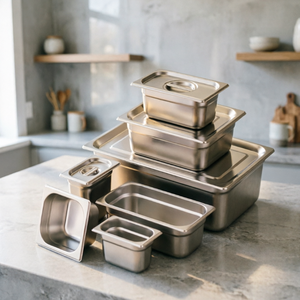
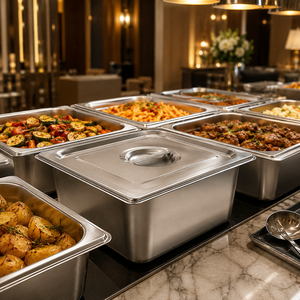
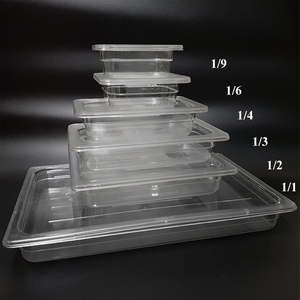
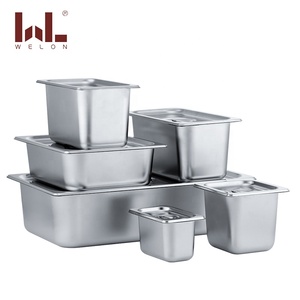
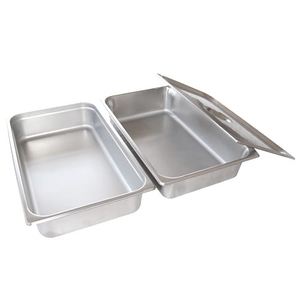
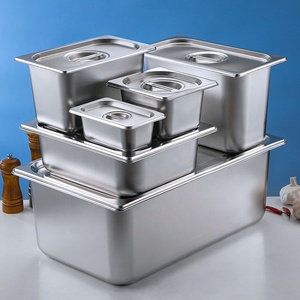
Gastronorm sizes are calculated on a modular fraction system based on the foundational GN 1/1 size (530 x 325 mm). OEM buyers must ensure exact dimensional precision so containers seamlessly drop into standard steam tables, chafing dishes, blast freezers, combi-steamers, and heated display counters.
| GN Designation | Standard Dimensions (mm) | Standard Depths Available | Approx. Capacity (200mm Depth) | Primary Commercial Application |
|---|---|---|---|---|
| GN 2/1 | 650 × 530 mm | 20, 40, 65, 100, 150, 200 mm | 58.0 Liters | Heavy commercial banqueting, central production kitchens |
| GN 1/1 | 530 × 325 mm | 20, 40, 65, 100, 150, 200 mm | 28.0 Liters | Standard steam tables, buffet chafers, combi ovens |
| GN 2/3 | 354 × 325 mm | 20, 40, 65, 100, 150, 200 mm | 18.0 Liters | Medium-scale combi ovens, compact catering lines |
| GN 1/2 | 325 × 265 mm | 65, 100, 150, 200 mm | 12.5 Liters | Salad bars, soup warmers, side dish presentation |
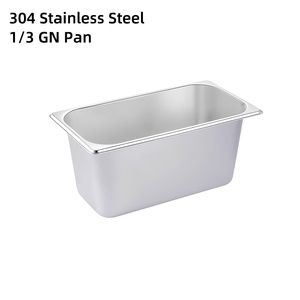
| GN 1/3 | 325 × 176 mm | 65, 100, 150, 200 mm | 7.8 Liters | Condiment stations, prep counters, vegetable holding |
| GN 1/4 | 265 × 162 mm | 65, 100, 150, 200 mm | 5.5 Liters | Topping stations, sauce holding, cold prep lines |
| GN 1/6 | 176 × 162 mm | 65, 100, 150, 200 mm | 3.4 Liters | Pizza prep tables, ice cream toppings, small condiments |
| GN 1/9 | 176 × 108 mm | 65, 100, 150 mm | 1.0 Liter | Specialty spices, micro-ingredients, coffee bar garnishes |
The operating environment dictates the alloy grade required. While AISI 304 (18/8 stainless steel) remains the gold standard for acidic food contact, high heat processing, and steam table use, alternative alloys and materials serve specific niche applications across the global HoReCa ecosystem.
Contains 18% Chromium and 8% Nickel. Highly resistant to organic acids, salt corrosion, and extreme thermal cycling (-40°C to +300°C). Mandatory for European and North American food-contact compliance (LFGB, FDA).
Substitutes part of the nickel content with manganese. Offers superior tensile strength and bright polished aesthetic at a lower material cost. Ideal for dry food holding, value buffet presentation, and general catering.
High-impact food-grade polymers designed for cold storage (-40°C to +99°C). Transparent design allows instant inventory visibility, perfect for cold prep tables, refrigeration units, and light-duty dry ingredient storage.
The commercial kitchen utensils industry is experiencing significant technological transformations driven by automation, energy conservation goals, enhanced hygiene mandates, and smart kitchen integration. Modern OEM factories are evolving beyond basic metal stamping to produce intelligent, highly engineered food containment systems.
Traditional flat-walled pans frequently jam together when stacked wet, causing operational delays and rim damage. Modern OEM designs feature specially engineered anti-jam stacking shoulder lugs pressed along the upper interior perimeter. This ensures seamless separation, enhanced airflow during drying, and reduced labor frustration in high-volume dishwashing operations.
Advanced combi-steamer technology demands specialized perforated Gastronorm pans with micro-punched hole matrices (typically 3mm to 5mm perforation diameters). Perforated pans maximize steam penetration, accelerate drainage during vegetable blanching, and speed up blast-freezing cycles by over 30% compared to solid metal containers.
Surface roughness (Ra value) directly impacts bacterial adhesion and ease of sanitation. Contemporary manufacturing incorporates electrochemical polishing techniques that reduce surface micro-grooves to an ultra-smooth Ra < 0.4 µm finish. This minimizes food residue buildup, reduces chemical sanitization requirements, and elevates overall food safety controls (HACCP compliance).
With the shift toward electric and induction-powered buffet stations, OEM manufacturers are developing encapsulated multi-ply bases (stainless-aluminum-stainless sandwich designs) for Gastronorm pans. These specialized bases eliminate hot spots, optimize thermal retention, and reduce energy consumption by up to 22% during extended buffet service holding.
Navigating the next decade of commercial kitchen procurement requires B2B importers, hotel chains, and restaurant equipment distributors to align with structural shifts in international trade, material sustainability, and custom brand integration.
Global enterprise buyers are actively implementing "China+1" and supply-chain resilience strategies. India has emerged as a powerhouse for precision stainless steel fabrication, combining competitive raw material access, skilled engineering manpower, and robust ocean shipping routes via ports like Nhava Sheva (Mumbai). Importers partnering with direct Indian OEM factories gain tariff advantages, stable pricing mechanisms, and customizable manufacturing agreements tailored to regional market standards.
Commercial distributors increasingly demand private-label custom branding directly from the factory. Advanced fiber laser etching allows permanent logo marking, volumetric interior measurement indicators (in liters/quarts), and batch traceability matrix codes on every GN pan rim without compromising surface hygiene.
Environmental guidelines are prioritizing zero-plastic commercial operations. Stainless steel Gastronorm pans offer an infinite recyclable lifecycle without property degradation. Enterprise procurement teams are specifying 100% recyclable metallic packaging and eco-friendly polishing compounds in OEM contracts to satisfy corporate ESG benchmarks.
The rise of smart ghost kitchens and automated banqueting management has created demand for GN containers fitted with heat-resistant RFID micro-transponders or barcode grooves. This enables automated real-time tracking of food holding times, wash cycles, and asset locations across large hotel properties.
Comprehensive technical and procurement guidance for international commercial cookware buyers, hotel supply chain directors, and wholesale importers.
Maintaining absolute consistency across thousands of stamped metal containers requires systematic quality control gates throughout the production workflow.
Every incoming stainless steel coil undergoes optical emission spectrometry to verify exact Nickel, Chromium, and Manganese composition percentages before entering the press line.
Random batch samples are checked using digital calipers and master fixture plates to verify flat flange alignment (+/- 0.5mm tolerance) ensuring airtight lid seals and smooth equipment drop-in.
Finished containers undergo salt-spray chamber testing (ASTM B117) and rapid thermal immersion cycling (-30°C freezer to +200°C steam) to verify weld seam and metal structural integrity.
Whether you are expanding your commercial kitchen supply portfolio, sourcing custom deep-drawn food containers, or seeking a direct Indian manufacturing partner for global distribution, our technical engineering team is ready to assist.