
Parin SteelsStainless Steel Kitchenware Manufacturer
Engineered for global wholesale distributors, HoReCa enterprises, and private-label brand owners. Compliant with international food contact standards.
An in-depth metallurgical and material analysis for B2B buyers evaluating factory specs, tensile tolerances, and food-safety certifications across global supply chains.
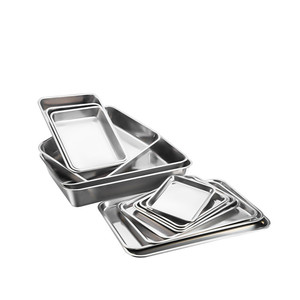
Commercial stainless steel serving trays demand rigid structural integrity to prevent flexing under heavy load capacities (exceeding 15-20 kg). Top-tier manufacturers like Parin Steels utilize precision hydraulic press machinery capable of deep-drawing 201, 202, 304, and 316-grade steel sheet circles. The selection of sheet gauge directly governs landed container cost and structural lifecycle:
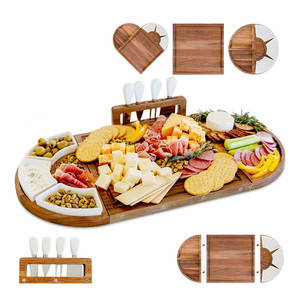
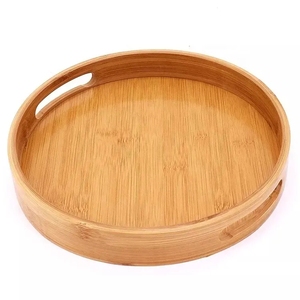
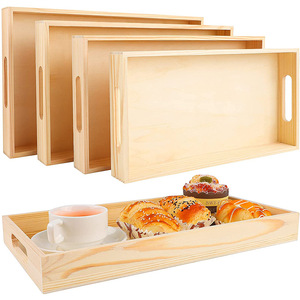
For organic serving platters—including magnetic charcuterie boards and tea trays—moisture retention control is critical to prevent warping or joint failure during ocean container freight. Leading factories execute kiln-drying schedules to lock internal wood moisture content between 8% and 11%.
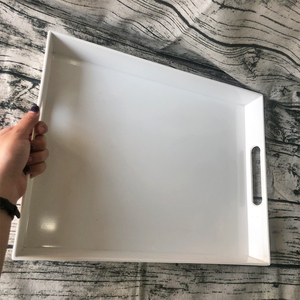
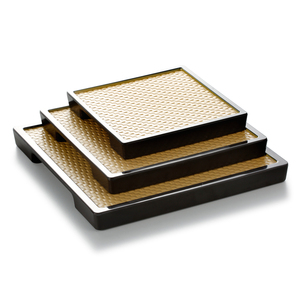
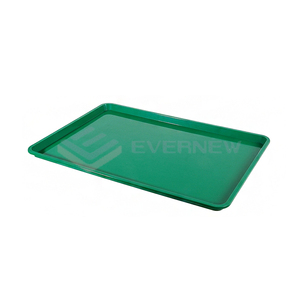
In thermosetting melamine tray production, compression molding at high temperatures (150°C to 170°C) ensures complete polymer cross-linking, producing a non-porous, dishwasher-safe surface with zero toxic leachates.
| Tray Material Substrate | Corrosion / Water Resistance | Impact & Shatter Resistance | Thermal Resistance | Primary B2B Target Market |
|---|---|---|---|---|
| SS 304 Food-Grade Steel | Maximum (Resists salts/acids) | Extreme (Indestructible) | Up to 800°C | EU/US Premium HoReCa & Institutional |
| SS 201 / 202 Commercial Steel | Moderate-High (Dry / Indoor) | High Structural Tensile | Up to 400°C | Mass Catering, Value Retail, South Asia |
| 100% Melamine (Thermoset) | High (Impervious to liquids) | High (Shatter-resistant) | -20°C to 120°C | Casual Dining, Outdoor Buffets, Parties |
| Kiln-Dried Acacia Hardwood | Moderate (Requires oiling) | Medium-High (Natural grain) | Up to 70°C (Not for cooking) | Charcuterie, Artisan Gifting, Cheese Boards |
| High-Impact Polypropylene | 100% Waterproof | Very High (Flexible polymer) | -10°C to 100°C | Fast Food Chains, Schools, Self-Service |
Navigating global supply chain shifts, sustainability mandates, and next-generation smart presentation hardware.
Global brand owners are rapidly diversifying their supply chains away from single-country dominance. High-capacity manufacturing hubs in India—anchored by established players like Parin Steels in Mumbai—offer distinct metallurgical expertise, lower export tariffs to key Western destinations, and direct sea-freight access via Nhava Sheva (JNPT) port.
Environmental packaging and product mandates in the EU (EU Deforestation Regulation - EUDR) and North America are reshaping timber tray procurement. Importers now demand FSC-certified bamboo and sustainable acacia paired with recyclable stainless steel components, eliminating single-use plastics from commercial dining setups.
Modern hospitality trends demand modular versatility. Trays integrated with rare-earth Neodymium magnets safely lock specialized cheese knives, ceramic sauce ramekins, or thermal cloches in place during rapid movement by banquet waitstaff, drastically reducing accidental spills and table service breakage.
Direct-from-factory production, transparent chemical compositions, and rigorous export quality assurance.
Headquartered on Panjrapole Road in Mumbai’s historic industrial hardware hub, Parin Steels operates under the direct leadership of owner Kekin Shah. By manufacturing in-house rather than outsourcing to unverified third parties, we provide full structural and chemical traceability on every stainless steel and kitchenware consignment.
Our strategic proximity to India's premier sea port, Nhava Sheva (JNPT), drastically reduces inland logistics overheads, permitting rapid FCL and LCL container loading for international bulk buyers across North America, Europe, the Middle East, and Africa.
Expert answers addressing material selection, custom branding, shipping logistics, and minimum order quantities.
For standard dry food serving, cafeteria trays, and budget-conscious retail lines, SS 201 and SS 202 offer high tensile strength and a bright mirror finish at an economical cost. However, for acid-heavy foods, high-salinity coastal environments, or strict European/North American food contact compliance, SS 304 (18/8 Chromium-Nickel) is recommended due to its superior corrosion resistance. Premium storage canisters and specialized trays utilize SS 316 with added molybdenum for maximum chemical defense.
In the Indian stainless steel manufacturing sector, bulk non-assembled utensils are commonly priced per kilogram (kg) of finished weight based on raw steel coil index prices. Specialized items like multi-piece wooden charcuterie sets, compartmented fast-food trays, and decorated melamine platters are quoted on a per-piece or per-set basis depending on tooling complexity, laser engraving, and custom master carton specifications.
Yes. OEM and ODM capabilities include custom laser-etched brand logos, precision die-stamped bottom emblems, custom handle attachments (wire, cast steel, or molded bakelite), and specialized surface finishes (satin brush, mirror polish, hammered thali texture, or PVD color coating). Customized box packaging and barcode inner sleeves are available for retail-ready distribution.
Standard production lead time ranges from 15 to 30 business days post-sample approval, depending on order volume and mold customization. Steel and melamine trays are nested with protective paper tissue interleaving to prevent friction scratches during ocean transit, then packed in heavy-duty 5-ply corrugated inner boxes and 7-ply export master cartons optimized for 20ft and 40ft FCL volume loading.
100% pure food-grade melamine serving trays are heat-resistant up to 120°C (248°F) and are fully safe for commercial conveyor dishwashers. Polypropylene (PP) compartment cafeteria trays are similarly engineered for continuous thermal cycles, retaining structural rigidity without warping or surface clouding.